
Kenya & Tanzania Camping Safari Experience: Sleeping Beneath Africa’s Wild Sky
An unforgettable journey through East Africa’s greatest wilderness
There is something magical about the moment the city disappears behind you.
The smooth highways gradually become dusty tracks. Telephone poles give way to towering acacia trees. Buildings are replaced by endless golden grasslands stretching toward the horizon, interrupted only by wandering giraffes, grazing zebras, and the occasional elephant crossing the road as if it owns the world—because here, it does.
For many travelers, a safari is simply another vacation. But for those who choose a Kenya and Tanzania camping safari, it becomes something much deeper. It becomes a return to nature, a lesson in patience, and a reminder that some of life’s greatest luxuries cannot be bought—they are experienced.
Imagine waking before sunrise, wrapped in the cool morning air, as the distant roar of a lion echoes across the savannah. The smell of freshly brewed coffee drifts through camp while the first rays of sunlight paint the African sky in shades of orange, pink, and gold. Somewhere nearby, elephants begin their daily march toward a river, while birds announce the arrival of another extraordinary day.
This is not television.
This is not a zoo.
This is Africa—wild, untamed, and unforgettable.
Where Two Legendary Safari Destinations Become One
East Africa is blessed with some of the world’s richest wildlife habitats, but nowhere compares to the combined beauty of Kenya and Tanzania.
Separated only by political borders, these neighboring countries share one of the planet’s most spectacular ecosystems. Wildlife moves freely across these ancient landscapes, following seasonal rains just as it has for thousands of years. Lions know no passport. Elephants ignore border signs. Wildebeest and zebras migrate across vast plains according to instinct rather than maps.
Traveling through both countries allows visitors to experience the complete story of East Africa’s wildlife.
One day you may find yourself watching thousands of wildebeest thunder across the plains of the Maasai Mara. A few days later, you’re standing on the rim of the Ngorongoro Crater, looking down into what many call Africa’s Garden of Eden. Then comes the endless Serengeti, where horizons seem to stretch forever and every drive feels like turning another page in nature’s greatest book.
Rather than choosing between Kenya or Tanzania, a combined camping safari lets you experience both, revealing how these extraordinary landscapes are connected by wildlife, history, and culture.
The Journey Begins in Kenya
For many adventurers, the journey starts in Nairobi, Kenya’s vibrant capital—a bustling city where modern life meets the wild.
Only a short drive beyond the city limits, the scenery begins to transform. Skyscrapers disappear in the rear-view mirror, replaced by rolling hills, open grasslands, and scattered villages where Maasai herders guide their cattle beneath enormous skies.
As you approach the Maasai Mara, excitement begins to build.
Then it happens.
A towering giraffe appears beside the road.
Soon afterward, a family of elephants slowly crosses your path.
Within minutes, zebras seem to be everywhere, peacefully grazing alongside Thomson’s gazelles while vultures circle lazily overhead.
Welcome to safari country.
The Maasai Mara is one of Africa’s most celebrated wildlife reserves, famous for its incredible concentration of predators and the annual Great Migration. Here, every game drive feels unpredictable.
A lion pride may be sleeping beneath an acacia tree.
A cheetah could suddenly sprint after an unsuspecting gazelle.
A leopard might be hidden high in the branches of a sausage tree, invisible until your guide points toward a dangling tail.
Nature writes its own script.
No two safaris are ever the same.
The Magic of Camping in the Wild
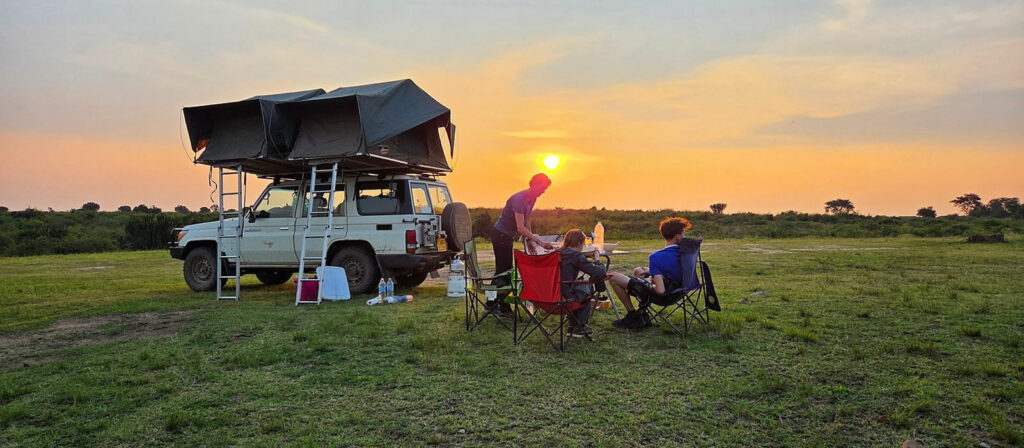
As afternoon fades into evening, your vehicle leaves the game tracks and heads toward camp.
Instead of checking into a concrete hotel, you arrive at something much more memorable.
Canvas tents stand neatly beneath towering trees.
Camp chairs surround a glowing fire.
The scent of dinner slowly fills the cool evening air.
As darkness settles across the savannah, the sounds begin.
Hyenas laugh somewhere in the distance.
Hippos grunt from a nearby river.
Owls call through the night.
Then, from far across the plains, comes the unmistakable roar of a lion.
It sends chills down your spine—not from fear, but from awe.
Inside your spacious safari tent, you’re comfortable and safe, yet fully immersed in the wilderness. There are no city lights to dim the stars, no traffic to interrupt the silence, and no alarm clocks. Nature itself sets the rhythm of the day.
It is often during these quiet evenings, gathered around a crackling campfire beneath millions of stars, that strangers become friends. Stories are shared, laughter echoes into the night, and tomorrow’s adventures begin to take shape in everyone’s imagination.
For many travelers, these simple moments become the memories they cherish most.
Crossing into Tanzania: A New Chapter
After exploring Kenya’s remarkable landscapes, the adventure continues south into Tanzania.
The border crossing marks more than a change of country—it marks the beginning of another chapter in an already unforgettable journey.
The roads wind through Maasai villages where brightly dressed warriors walk alongside their livestock, maintaining traditions passed down through generations. Mount Kilimanjaro occasionally appears in the distance, its snow-capped summit rising above the plains like a silent guardian of East Africa.
Before long, the gates of Serengeti National Park come into view.
The name “Serengeti” comes from the Maasai word Siringet, meaning “the place where the land runs forever.”
Standing here for the first time, it is easy to understand why.
The landscape seems endless.
Golden grass waves gently in the breeze.
Lone acacia trees punctuate the horizon.
The sky stretches farther than imagination.
Here, every direction promises another discovery.
A coalition of cheetahs scans the plains from a termite mound.
A family of elephants disappears into the distance.
Thousands of wildebeest graze peacefully, unaware that lions may be watching from nearby grass.
The Serengeti is not simply a destination.
It is one of Earth’s last truly wild places, where life unfolds much as it has for millennia.
Following the Great Migration and Discovering Tanzania’s Wild Heart
The Serengeti has a way of changing your sense of time.
Hours pass without you noticing. There is no rush, no schedule dictated by traffic lights or office meetings. Instead, your day is measured by the movement of wildlife, the position of the sun, and the whispers of the wind through the tall grasses.
As your safari vehicle rolls slowly across the endless plains, your guide suddenly raises a hand.
“Listen.”
The engine falls silent.
At first, there is only the breeze.
Then, almost imperceptibly, a distant rumble begins to build.
It grows louder.
Soon the horizon itself appears to move.
Thousands become tens of thousands.
Then hundreds of thousands.
An ocean of wildebeest stretches as far as the eye can see, accompanied by zebras and gazelles, all moving together in one of nature’s greatest spectacles—the Great Migration.
Dust rises into the morning sky as hooves pound the earth in perfect rhythm. Calves stay close to their mothers while dominant bulls lead the way across rivers, valleys, and open plains. Above them, vultures circle patiently, while lions, hyenas, and crocodiles watch for opportunities created by the endless procession.
No documentary can prepare you for the sheer scale of it.
You don’t simply watch the migration.
You feel it.
The vibrations travel through the ground beneath your feet, reminding you that this incredible event has taken place for thousands of years, long before roads, borders, or safari vehicles existed.
For photographers, every second offers another masterpiece.
For first-time visitors, it is often an emotional experience.
For seasoned travelers, it is a reminder that nature remains the world’s greatest storyteller.
Life Around Camp
After a full day exploring the Serengeti, returning to camp feels surprisingly comforting.
The tents glow warmly beneath lantern light.
The campfire is already burning.
Dinner is being prepared while fellow travelers exchange stories about the day’s sightings.
Someone saw a leopard dragging its prey into a tree.
Another witnessed a cheetah chase across the plains.
One couple spent nearly an hour watching elephant calves play in a muddy waterhole.
No two safari vehicles followed exactly the same route.
No two people experienced the same day.
That is one of the greatest joys of safari.
Nature never repeats itself.
As darkness settles, millions of stars begin to appear overhead. Far from city lights, the Milky Way stretches across the African sky with astonishing clarity. The sounds of the wilderness return once more—the haunting call of an owl, the distant whoop of hyenas, the splash of a hippo in a nearby river.
Camping allows you to experience these moments in a way that hotels simply cannot. You are not separated from nature by thick walls or air-conditioned rooms. Instead, you become part of the landscape, sharing the night with the wildlife that calls it home.
The Ngorongoro Crater: Africa’s Natural Amphitheater
Leaving the Serengeti behind, the journey climbs steadily into the lush highlands of the Ngorongoro Conservation Area.
The air becomes cooler.
The vegetation changes.
Dense forests replace open grasslands.
Then, after winding through mist-covered hills, you reach one of Africa’s most breathtaking viewpoints.
Standing on the rim of the Ngorongoro Crater is an experience that words struggle to capture.
Nearly 600 meters below lies a perfectly preserved volcanic caldera covering more than 260 square kilometers. It looks less like a crater and more like an entire world hidden within the Earth.
As your vehicle descends the winding road into the crater, every turn reveals another extraordinary scene.
Buffalo graze beside zebra.
Hippos lounge in freshwater pools.
Flamingos add splashes of pink to the soda lake.
Jackals patrol the grasslands.
Lions rest beneath yellow fever trees.
The Ngorongoro Crater is one of the few places in East Africa where visitors have an excellent chance of spotting the endangered black rhino in its natural habitat. Protected by the crater’s natural walls, these magnificent animals continue to thrive in one of Africa’s most successful conservation areas.
For many travelers, this becomes the highlight of their safari.
The diversity of wildlife, combined with the dramatic scenery, creates an atmosphere unlike anywhere else on the continent.
Tarangire: The Kingdom of Giants
Many visitors arrive at Tarangire National Park with few expectations.
They leave wondering why they had never heard more about it.
Tarangire is a land of giants.
Giant baobab trees stand like ancient guardians, some believed to be over a thousand years old.
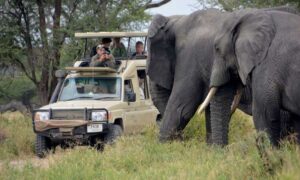
Massive elephant herds roam the landscape, sometimes numbering more than one hundred individuals.
Watching these gentle giants interact is one of safari’s greatest pleasures.
Young calves hide beneath their mothers.
Teenage elephants wrestle playfully with one another.
Older bulls stroll confidently across the plains, their enormous tusks reflecting the afternoon sunlight.
During the dry season, the Tarangire River becomes the park’s lifeline, attracting wildlife from across the region.
Zebras gather alongside wildebeest.
Impalas cautiously approach the water.
Giraffes browse peacefully among umbrella acacias.
Meanwhile, predators remain close behind, patiently waiting for opportunities.
Unlike some of Africa’s busier parks, Tarangire often feels quieter and more intimate, allowing visitors to enjoy extraordinary wildlife encounters without large crowds.
Meeting the Maasai
A safari through Kenya and Tanzania is about far more than wildlife.
It is also a journey into one of Africa’s richest cultural landscapes.
Across both countries live the Maasai people, renowned for their vibrant red clothing, intricate beadwork, and deep connection to the land.
Visiting a Maasai village offers travelers the opportunity to learn about traditions that have endured for centuries.
Children greet visitors with curious smiles.
Warriors demonstrate their famous jumping dance.
Elders explain how livestock remains central to their way of life.
Women proudly display handcrafted jewelry, each piece carrying cultural significance.
The visit is not about entertainment.
It is about understanding how people and wildlife have coexisted across these landscapes for generations.
Many travelers leave these encounters with a deeper appreciation of East Africa—not only for its wildlife but also for the communities that help protect it.
Every Sunrise Brings a New Adventure
One of the greatest pleasures of camping is the rhythm of each day.
Before dawn, camp begins to stir.
Coffee brews over the fire.
Breakfast is served while the sky slowly brightens.
Then comes that magical moment when the first rays of sunlight illuminate the savannah.
Morning is often the best time for wildlife viewing.
Predators remain active after the cool night.
Leopards descend from trees.
Lions patrol their territories.
Cheetahs climb termite mounds to scan the plains.
Elephants feed peacefully before the afternoon heat arrives.
Each sunrise feels like the opening chapter of a brand-new story.
And every game drive holds the promise of something extraordinary just around the next bend.
Why Camping Creates the Strongest Memories
Luxury lodges certainly offer comfort.
But camping offers connection.
It connects you with nature.
It connects you with fellow travelers.
It connects you with the ancient rhythms of Africa itself.

You notice things you might otherwise miss:
- The changing colors of the sky before sunrise.
- The scent of rain drifting across distant plains.
- The chorus of insects after sunset.
- The silence that follows a lion’s roar.
- The countless stars visible without city lights.
These are the moments that remain long after photographs have been shared and souvenirs packed away.
Years later, travelers may forget the name of a particular campsite, but they rarely forget the feeling of falling asleep to the sounds of the African wilderness or waking to another day of adventure.