
Lake Manyara National Park
Lake Manyara National Park is an exceptional tourist attraction located in the Arusha and Manyara regions, near Arusha town. It is part of the greater Lake Manyara Biosphere Reserve and encompasses an area of 325 square kilometers, situated at the base of the Rift Valley escarpment, with an altitude ranging from 3,130 to 6,742 feet. The majority of Lake Manyara National Park consists of a short strip situated between the Gregory Rift wall to the west and Lake Manyara to the east.
History of Lake Manyara national park
Historically, the region encompassing Manyara National Park was formerly designated for sport hunting. Due to the abundance of wildlife species inhabiting the area, it was established as a game reserve in 1957 and subsequently elevated to national park status in 1960. Initially, Manyara National Park encompassed a lesser area than it does presently, but property was incrementally incorporated to expand its size; in 1974, 1,400 acres were added to the park’s territory. The park was designated a UNESCO site due to its exceptional ecological preservation.
Attractions in Lake Manyara national park
Wildlife
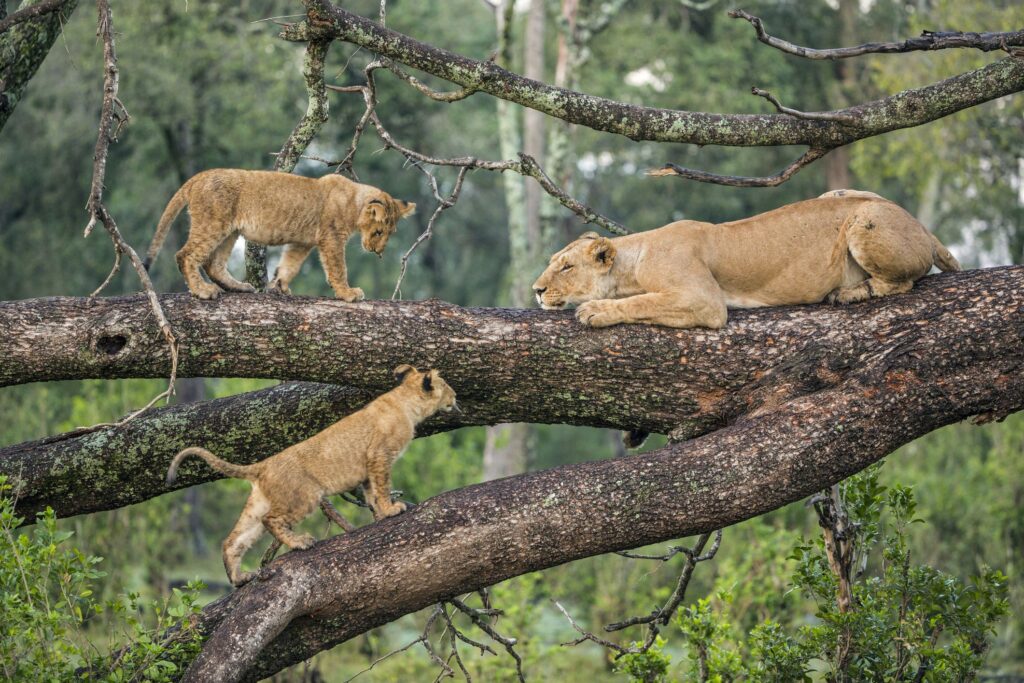
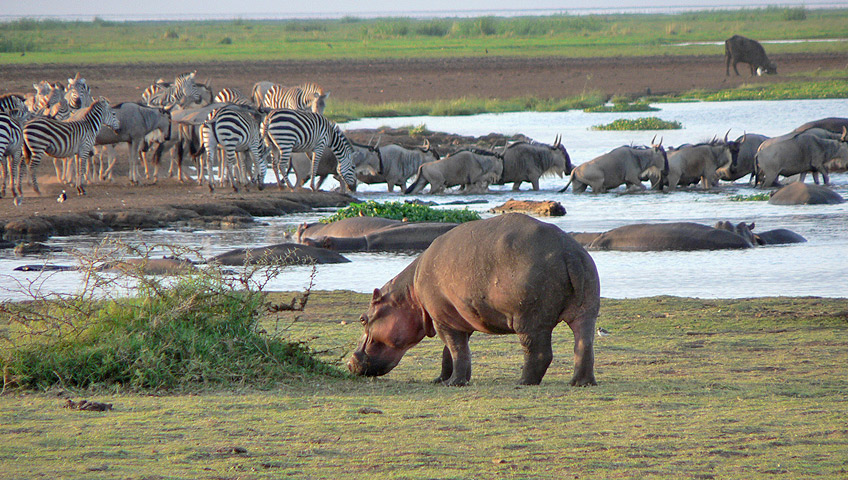
Wildlife constitutes a primary attraction of Lake Manyara National Park, which hosts a substantial number of animals that flourish in the short savannah grasslands interspersed with predominant shrubs. Among the fauna in Lake Manyara National Park, notable large species favored by travelers on safari include tree-climbing lions, leopards, elephants, wildebeests, and giraffes. Additional fauna observed in Manyara National Park encompasses antelopes, zebras, hippopotamuses, and occasionally hyenas, as well as cape clawless otters and pairs of klipspringer, typically seen precariously perched on the cliffs in the southernmost area of the park. The park is characterized by fragmented woods that provide as a habitat for primates, notably hosting a substantial population of baboons exceeding hundreds. Other primates found in Manyara National Park include the olive baboon and the blue monkey.
Birds
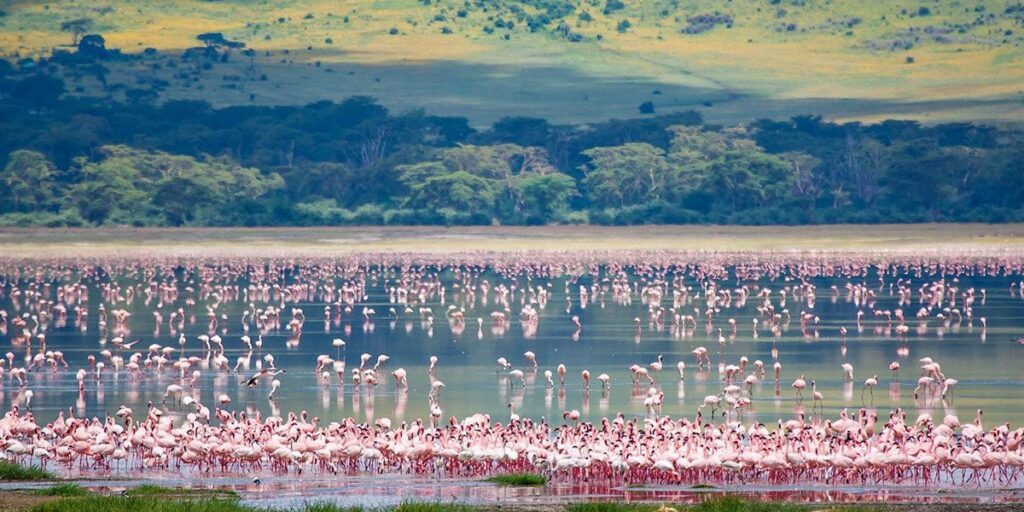
Lake Manyara National Park is a birdwatching haven, with around 400 avian species. These vibrant and diverse birds often inhabit the swampy vegetation surrounding Lake Manyara, as well as the park’s woods and savannah grasslands. Bird species observed in Manyara National Park include pelicans, pink flamingoes, spoonbills, egrets, herons, storks, waders, crowned eagles, crested guineafowl, silvery-cheeked hornbills, Abdim’s stork, African fish eagle, African grey hornbill, African hawk eagle, African jacana, African spoonbill, baglafetch weaver, comb duck, great white pelican, greater flamingo, grey crowned crane, hammerkop, Hottentot teal, lesser flamingo, little stint, pied avocet, pied kingfisher, pink-backed pelican, sacred ibis, saddle-billed stork, southern ground hornbill, spur-winged goose, von der Decken’s hornbill, yellow-billed stork, and numerous others.
Lake Manyara
Lake Manyara, a prominent attraction in Manyara National Park, is a closed basin lake sustained by subterranean springs, as it lacks any outflows. The lake encompasses a surface area of 181.5 square kilometers and reaches a depth of 3.7 meters, rendering it the seventh-largest lake in Tanzania by surface area. Lake Manyara has numerous fish species, mostly tilapia and catfish. A significant feature of the park is the high concentration of flamingos that feed along the lake’s edge during the wet season.
Activities at Lake Manyara National Park
Game drive
Lake Manyara National Park provides one of the premier game drive safaris in Tanzania, characterized by picturesque and serene landscapes formed by escarpments, the lakebed, short grasslands, and forested galleries. Lake Manyara National Park is inhabited by numerous wildlife species, including four of the five big five: leopards, tree-climbing lions, buffalo, and elephants, who are readily observed feeding and roaming throughout the park. Numerous additional creatures can be readily observed in the plains of Manyara National Park, including wildebeest, bushbucks, giraffes, klipspringers, zebras, hyenas, and primates such as olive baboons and blue monkeys.
Game drives in Manyara National Park are conducted in sessions: morning, afternoon, and night, the latter for observing nocturnal species like as lions. The optimal period for wildlife observation in Lake Manyara National Park is from June to October, during the dry season when vegetation is generally sparse, facilitating unobstructed views of the species.
Bird watching
Manyara National Park is an excellent location for avian observation and serves as a sanctuary for ornithological enthusiasts. Lake Manyara National Park is home to over 400 bird species, which inhabit various sections of the park. Species such as pink-hued flamingos inhabit the waterways of Manyara, while egrets, stilts, herons, spoonbills, and storks are observed around the edges and floodplains. Additionally, crowned eagles, crested guineafowl, and silvery-cheeked hornbills are found in the woodlands. Numerous avian species observed in Manyara encompass the African hawk eagle, African jacana, African spoonbill, Baglafetch weaver, comb duck, crowned eagle, great white pelican, greater flamingo, grey crowned crane, hammerkop, hottentot teal, lesser flamingo, little stint, pied avocet, pied kingfisher, pink-backed pelican, sacred ibis, saddle-billed stork, silvery-cheeked hornbill, southern ground hornbill, spur-winged goose, von der Decken’s hornbill, yellow-billed stork, among others.
Lake Manyara National Park attracts migrating bird species from November to April, with the optimal time for birdwatching occurring throughout this interval. This period marks the presence of migratory birds in the park, coinciding with their breeding plumage.
Nature tour
A nature walk safari in Manyara National Park is an excellent activity for appreciating the park’s grandeur, typically conducted in the afternoon following a wildlife drive. Nature walks entail traversing the stunning plains on foot. While walking, you can appreciate the vistas of Lake Manyara and the Rift Valley, along with other fauna inhabiting the park, including zebras, baboons, warthogs, giraffes, impalas, elephants, hippos, wildebeests, and the uncommon tree-climbing lions, among others.
Best time to visit Lake Manyara national park
Manyara National Park is a remarkable destination featuring exquisite wildlife and stunning landscapes, providing an exceptional safari experience in Tanzania, but visits to the park are favorable year-round. The optimal period for a safari visit to the park is from late June to September, as this timeframe constitutes the dry season, characterized by short grass cover that facilitates unobstructed views of the wildlife and the picturesque plains of Lake Manyara.
Directions to Manyara National Park
Lake Manyara National Park is an easily accessible tourist site located in the renowned northern circuit of Tanzania. Tours and safaris to the park typically commence from Arusha, allowing for convenient access by both air and road transportation. The most efficient and straightforward method is to fly to Arusha town via Kilimanjaro International Airport, Arusha Airport, or Julius Nyerere International Airport. Chartered domestic flights are available from Arusha town to Manyara airfield. The park’s headquarters is a 10-minute drive from the airstrip.
Manyara National Park is located 126 kilometers southwest of Arusha, easily accessible by automobile within a 1-2 hour journey to the main entrance gate.
Accommodations in Lake Manyara National Park
Lake Manyara National Park features numerous exquisite accommodation options that provide comfortable beds, amenities, and delectable meal plans. These establishments are located both within the park and in its vicinity, including Lake Manyara Plantation Lodge, Manyara Tree Lodge, Manyara Ranch Conservancy, Isoitok Camp Manyara, Manyara Serena Lodge, Kiruruma Tented Lodge, Lake Burunge Tented Camp, Lake Manyara Wildlife Safari Camp, Haven Nature Camp and Lodge, Lemala Manyara Camp, Lake Manyara Hotel, Eunoto Retreat Manyara, Lake Manyara View Lodge, among others.